Sunday, 25 March 2018

Olympics 2018!

We enjoyed the Olympics in Room 122. There is something special about being able to experience the Olympics alongside our students who have never seen an Olympics before. We provided opportunities for our learners to share their expertise and learn about various winter sports.

Our 'Olympic Centre' aka the area our learners could spend learning about the various winter sports. This provided many natural writing opportunities for them to share wonders, learning and excitement through drawings and words.

Word walls to support independence with writing


A 4 person bobsleigh


Our learners had many different wonders about the various sports. Thanks to CBC Kids, we were able to watch many great videos teaching us about each of the Olympic sports.

"I wonder what you do with them (the Olympic rings)?
"I wonder why it's (the rings) connecting together?"- S.F
"I wonder why there is blue, yellow, red, black, and green?"- E.M.
"I wonder why you have to wear white skates when you figure skate?"- L.G.
"I wonder if they (figure skaters) get dizzy?"- S.A.
"I wonder why you have a hockey stick to score?"- J.C.
"I wonder if you win do you get a trophy?- A.H.
"I wonder why they push the broom in front?"- B.K. (about curling)
"I wonder why they have to put the thing (curling rock) on super close to the button?"- A.B

We competed in our own Room 122 Olympics using many of our math skills to determine length, proximity and time.

Ski jumping


Curling


Speed skating

Medals


We were so impressed with all of the Canadian athletes. Looking forward to the next Olympics!

Saturday, 3 March 2018

Spatial Reasoning Skills

As an educator team, we have been exploring the importance of teaching spatial reasoning to our mathematicians. We have been amazed at the complexity of thinking required to be efficient with these skills. As educators it is important we are providing many opportunities for our learners to explore geometry-- and recognizing that geometry is much more than just naming shapes and stating their attributes. Spatial reasoning can be broken down into the following skills (from Taking Shape):

  • Visualization 
  • Mental rotation
  • Visual-spatial working memory
  • Information processing
  • Spatial langugae
  • Gestures
We need to be looking at all of these skills when exploring geometry, not just the language piece. This also provides an access point for all learners, no matter their skills.


The Hexagon Card Game from Taking Shape (see below) 
A symmetrical design
Recreating her design
Directional language & coding 
Using mandalas to create symmetrical designs


Finding pentominoes that fit where the cubes or spaces are.


If you're looking for some practical resources to support your own learning about spatial reasoning, here are a few we enjoy:

Taking Shape - As a Kindergarten team, we are working through this book. It has lesson plans, activities and black-line masters. We highly recommend this.

Paying Attention to Spatial Reasoning


Five Compelling Reasons for Teaching Spatial Reasoning to Young Learners

Why Spatial Reasoning is Crucial for Early Math Education

Monday, 27 November 2017

Mathematicians at Work!

- Ontario Kindergarten Program Document

We have been learning a lot about mathematics as an educator team this year. Mostly we have been learning to take on the observer role and notice all the math our learners are doing daily. From there we have been supporting their math thinking. Our mathematicians this year have been exploring counting and numbers in their play very regularly. They have become curious and fascinated about using math tools to count large volumes of materials and exploring growing number patterns through building. What has been so interesting to us is that many different mathematicians are beginning to explore these concepts at their developmentally appropriate level. Math through play allows learners to enter in at their level but to be challenged to expand their thinking and skills.

Our mathematicians observe what their peers are doing and then work to create their own representation.


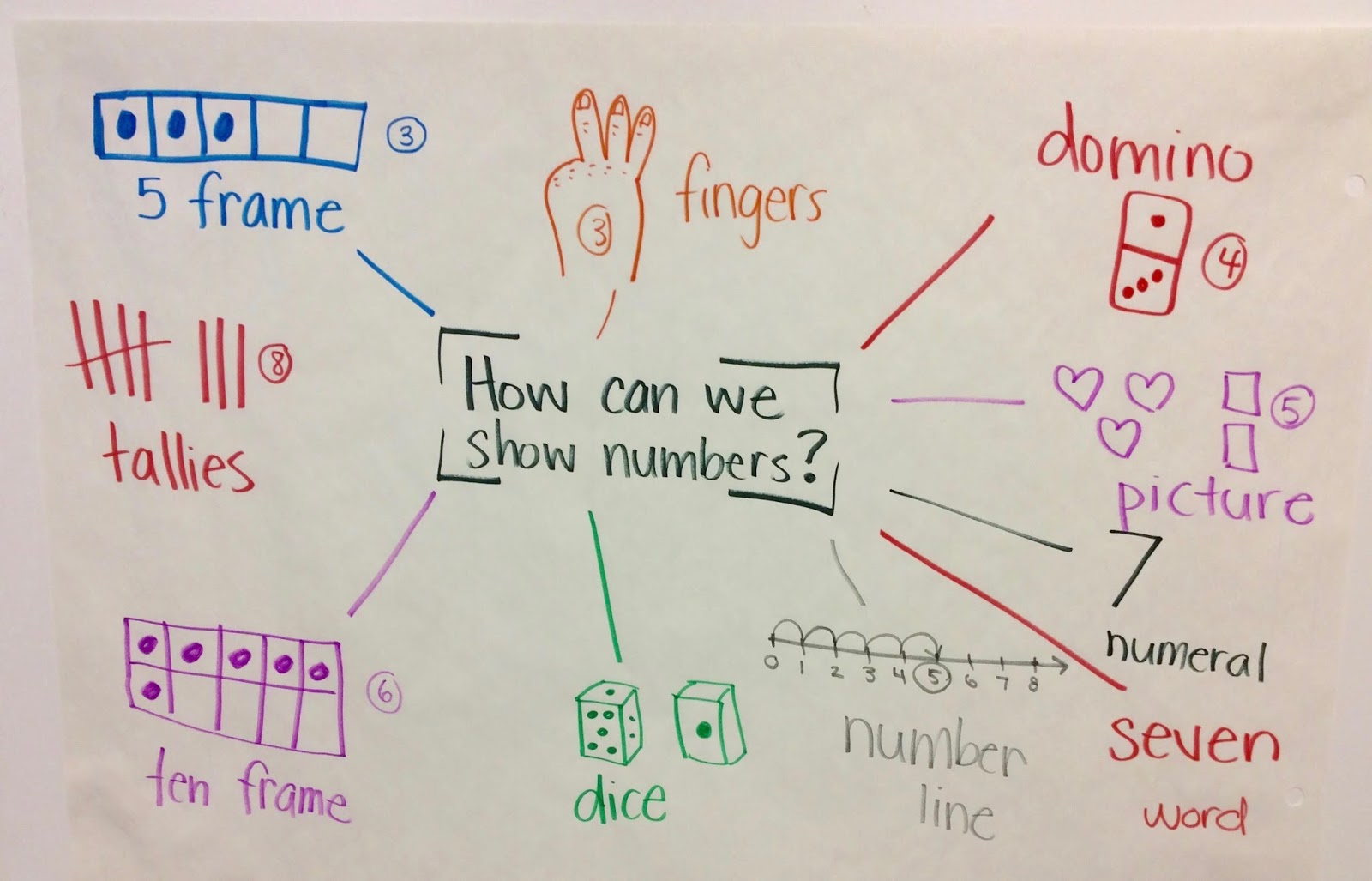
Our mathematicians explored how they can show numbers. They loved using 10 frames as a tool for showing numbers.


We also used numerals and dice to show numbers.


Working on sorting and counting the number of sides on the shapes.
Mathematicians explore numbers outdoors during Outdoor Learning. Two boys worked together to use their bodies to create numerals. We always have clipboards available during outdoor learning and this Year 1 decided to show her thinking of how to add numbers together.


Retelling stories through the use of math.


Playing the game Tenzis to work on subitizing skills.


This mathematician created a growing pattern through the use of addition sentences (see the white board). She was then encouraged to use the counters to show her thinking. She was then able to see the pattern growing and determine which would come next.


Another way to use counters to show knowledge of numbers.


Creating towers of numbers and noticing the patterns inside them became a favourite of our mathematicians. They created growing patterns inside their towers or growing patterns between the towers. Once one student tried it, others were inspired as well. 


As a class we counted the seeds in our pumpkin. We used 10 and 5 frames to help us. Afterwards a group of students worked together to count all the seeds from the other pumpkin. They persisted and filled the entire carpet with 10 frames to count the seeds. They shared their work with the class and this has since inspired many variations of counting materials in the room. 


Counting the manipulatives
Sorting and counting the 3D shapes.
Sorting by colour, counting and recording the number on sticky notes.


After sorting the colours at the light table these girls worked together to count each colour and then record the total with numbers.


Another group did the same thing another day
Counting and representing


With all this counting we have begun to explore efficiency of strategies (i.e. counting every single counter starting at 1 is going to be hard and take a long time). Many of our mathematicians will tell you that we should count by 10s. To build their fluency with counting by 10s we have listened to some songs.


We're looking forward to seeing what our mathematicians do next!