Sunday, 26 April 2015

Splendid Little Mathematicians

"We can say... that young children are splendid little mathematicians. They deal spontaneously and sometimes joyfully with mathematical ideas. This is what real mathematicians do.”
(Ginsburg, 2008, p. 55)- Building Capacity Series


We put out a variety of materials to encourage the students to measure around the classroom. They have been really enjoying exploring and trying out these new measuring tools.


They explored length:

M.W. measure B.G, using her hand to show where B.G's head goes on the measuring tape
Beginning to explore with measuring tapes
A.K measured the Smart Board and then wrote about it (see below).
"what do we do when someone is longer than the measuring tape?" Working with Ms. Tompkins to use two.
Using one-to-one correspondance to count the measuring tape
Working together makes measuring easier!
Measuring around the room!
The students measured Floppy too!
(Click here to learn who Floppy is!)


They explored weight:

Girls exploring what is heavier and lighter than a hexagon
A.K exploring what is heavier than a cylinder, he found a block, portfolio and this ruler are all heavier than the cylinder


They explored temperature:

Watching the thermometer to find out what happens when it is put into ice water
Ms. Tompkins- why do you think the red went down?
R.H- It’s going down! Because it’s at number zero
J.A- because the number go down
A.P- it’s colder, like snow and ice
I.S- because it’s colder


Together we worked on exploring and writing about our observations of the thermometer. 


What amazing, child-driven learning has been happening in our classroom this month! 

What measurement opportunities do you see around you?

Wednesday, 15 April 2015

Spring is Finally Here!

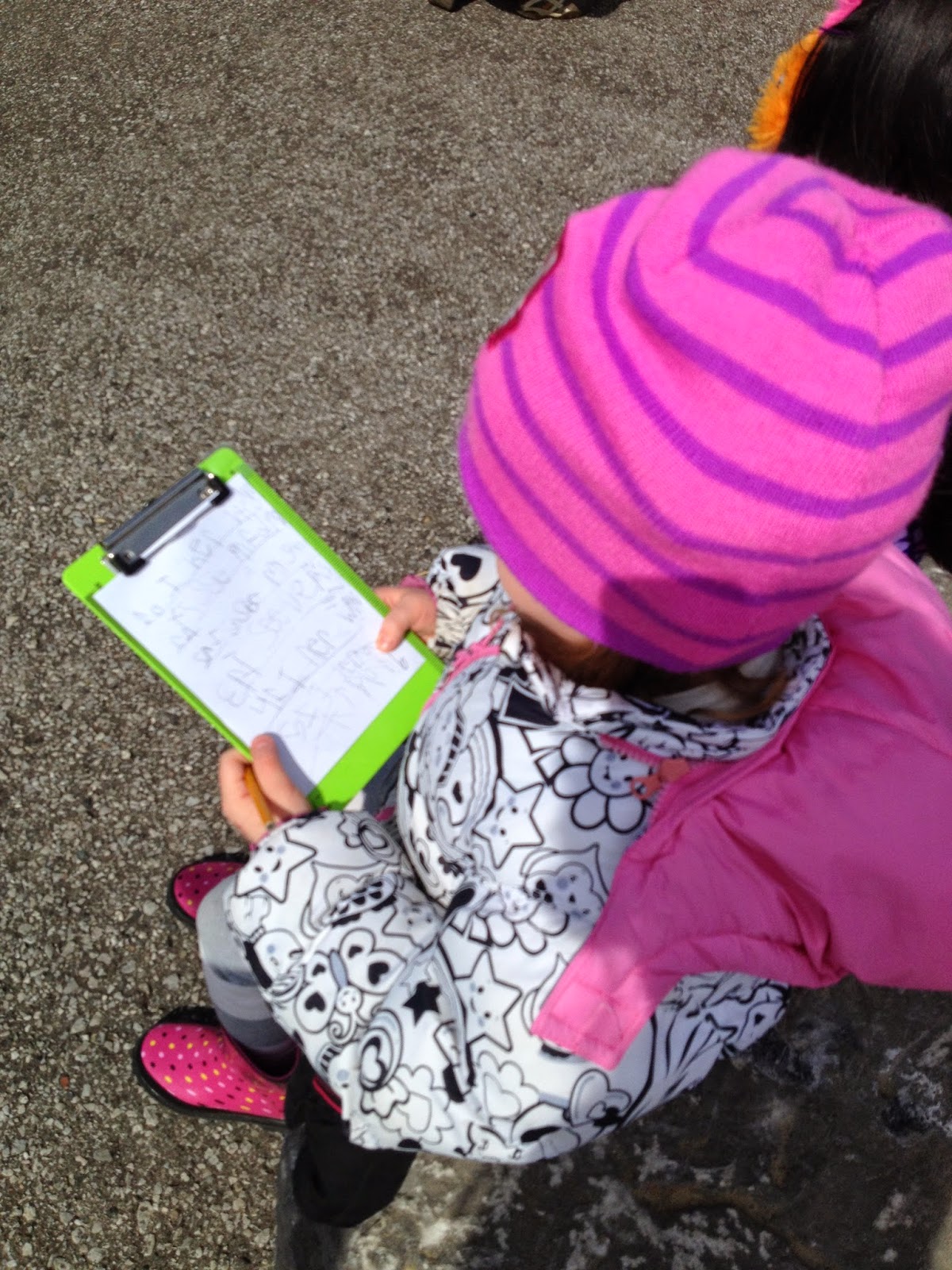
We have been loving this spring weather! To celebrate spring and look for different signs that tell us it's spring, we went on a nature walk. The students brought along their clipboards to record the things they saw and heard. They worked in partners and it was fabulous to see how they worked together to stretch out words and record their observations.


Noticing 'environmental print' and using it to help them record their observation of a park
"it feels like straw"


So excited to be outside!


"we found a daisy!" The students were excited to see this sign of spring.
While we were walking back to our class I noticed something move on the sidewalk. We looked down and it was a little snake! The students were so excited! 

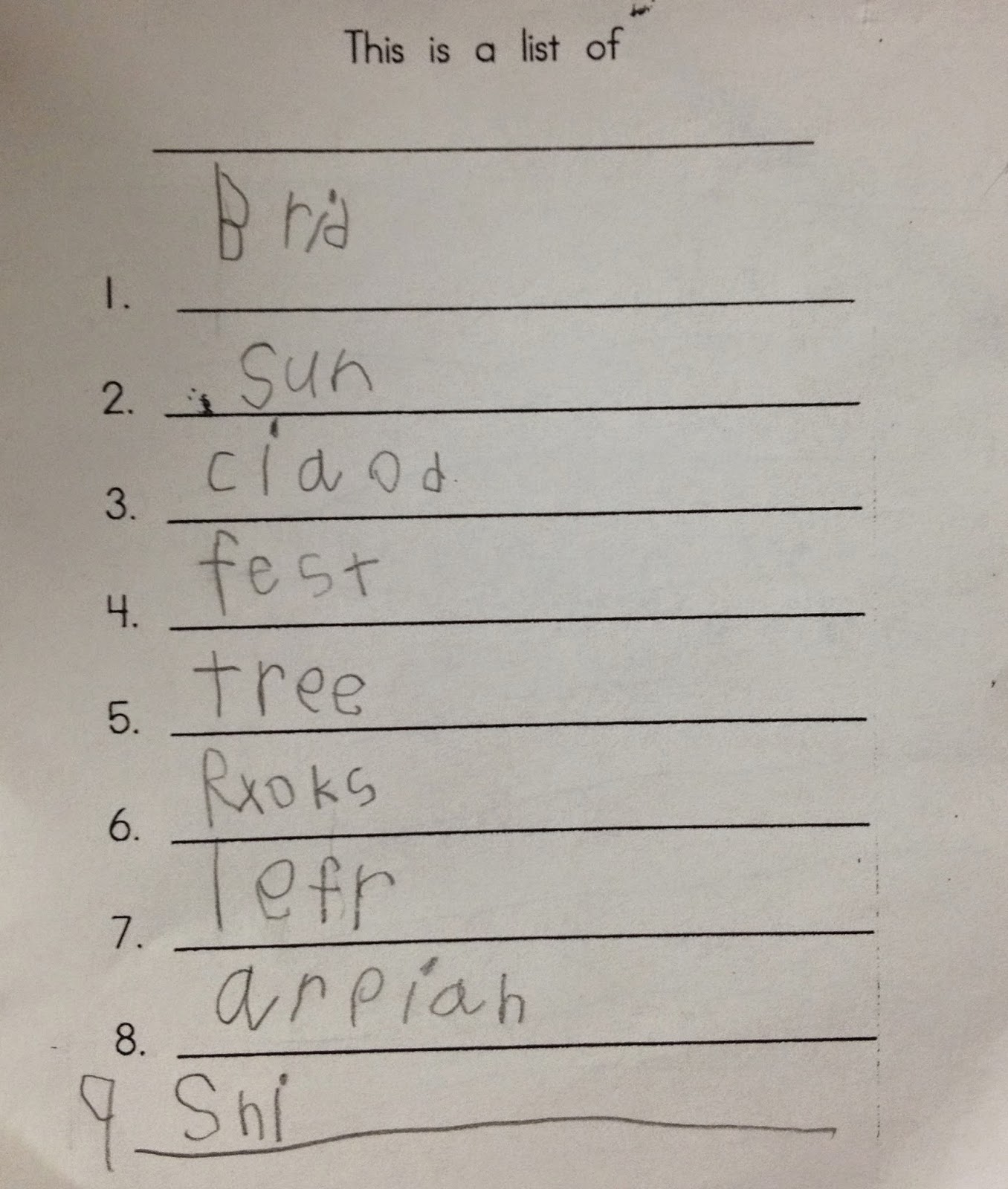
Adding 'snake' to their observation lists

“It is important to explicitly ask children to share their questions. They need to know that we want to know their questions. They need to know that they can wonder out loud.”
– Carol Stephenson, Natural Curiosity 


Throughout the walk the students were focused on observing everything around them using their senses. They heard birds chirping, airplanes flying and the wind rustling leaves and grass. They saw lots of detail out in nature. They felt the difference between rocks, grass and twigs. Our class is full of scientists! Here are their lists.


We are hoping that the weather stays nice so we are able to get outside and do some more learning and wondering outdoors. 

Tuesday, 7 April 2015

Composing and Decomposing Numbers

A group of girls worked on ways to represent the number seven, using stones. I asked them how they could make 7 using green and brown stones. The girls got to work quickly.


Drawing her representation of 7

Using classroom resources to support writing the numbers 
I.L made 7 using 4 green and 3 brown. Together, we wrote the math sentence 4+3=7.
D.M made 7 using 1 green and 6 brown.
A.H made 7 using 3 brown and 4 green.
These girls are demonstrating the skill 'composing and decomposing numbers'. This means the ability to build and take apart numbers.

This skill can be taught in many different ways and naturally throughout your day. Here are a few examples of ways you can get your child to think about numbers being broken apart and put together.

  • I have 8 socks. Some are blue and some are pink. What socks could I have? (You could challenge your child to see how many ways they could do this)
  • Nine grapes were in my bowl. I ate 3 grapes. How many grapes are in my bowl now?
  • Six crayons are in the box. Two are red and the rest are blue. How many blue crayons are in the box?
We use many different manipulatives to help the students build this skill, here are a few. 
  • 10 frames and 5 frames with different coloured counters
Showing 5 with 3 white and 2 red 
  • Snap cubes
Making 5
This is an important skill for the students to gain a foundational knowledge and understanding of numbers. We are excited to continue to watch them learn and explore this concept of composing and decomposing numbers.