"Art has the role in education of helping children become like themselves instead of more of everyone else"
-Sydney Clemens
At the beginning of each school year, we spend a lot of time learning about emotions and self-regulation. We use the Zones of Regulation to support building language around feelings and emotions (See last year's post about how we use Zones by clickinghere). We spent time reading a variety of books about different feelings.
We learned that all feelings are okay. It's okay to be sad, or scared, or angry, or frustrated, or happy.
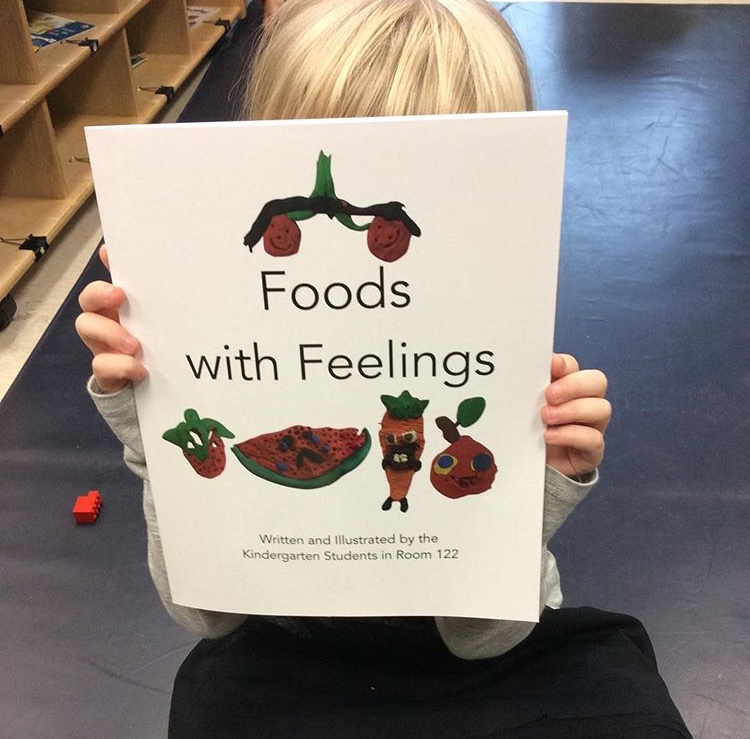
We read the book 'How are you Peeling? Foods with Moods', which inspired a wonderful art and literacy project for our learners. Our artists decided they wanted to create their own foods with feelings.
Our artists used their knowledge of feelings to create a representation of different emotions using clay/plasticine.
We then turned their artwork into a book! Our writers added words to describe each feeling.
(We used the company Book Bub to have our book published).
Our spider inquiry continued to grow! We learned so much about spiders and even got to speak with experts. While we were learning about spiders, the ROM (Royal Ontario Museum) had a spider exhibit. As we were unable to organize a last minute affordable trip down, we contacted the ROM to see what our options were. We ended up having a video call with their 'spider wrangler' and a scientist and it was AMAZING!
Our learning about how spiders catch their prey- we added to this chart as we learned
A spider web created by J.C.
A trapdoor spider created by P.X.
A spider using a sticky globule to catch a bug by B.R.
Students showed their learning in play all over the classroom!
We created these Peacock Spider holiday gifts for the families.
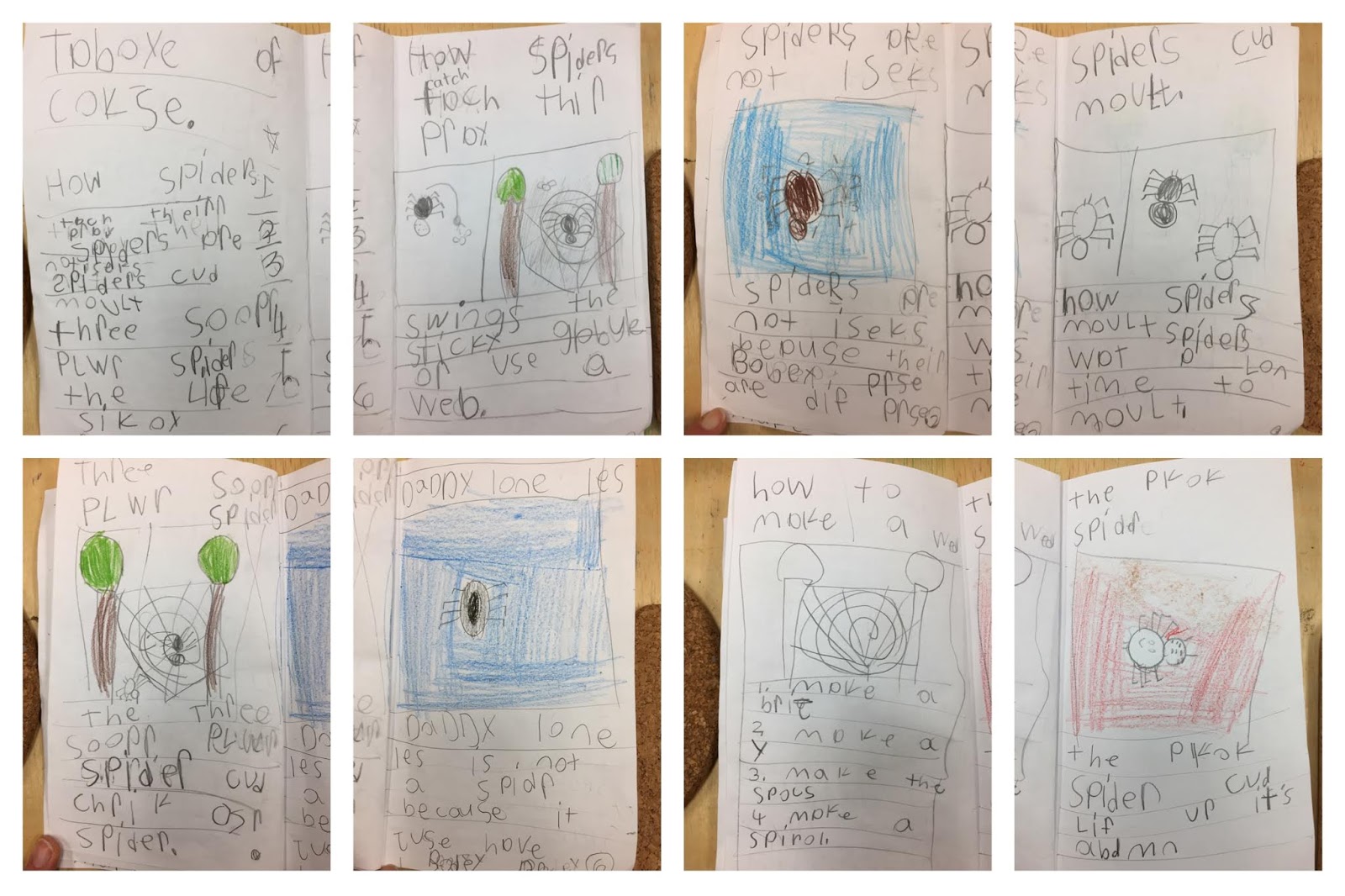
After reading many non-fiction books about spiders, our authors wrote and illustrated their own:
By: D.K.
By: P.X.
By: D.S.
By: J.C.
By: P.W.
Before our call with the ROM, our learners wanted the experts to know all the information we knew. So they decided to use mind maps to share all their knowledge. They then wrote the questions they wanted to the spider experts to answer and we sent them ahead of time to the ROM.
And then we had our call!
This is a moulted exoskeleton of a Goliath Birdeater Spider
Doing the Peacock Spider dance
A big thanks to the ROM! We are now all spider experts! What a great way to end our inquiry.
We have been learning so much about spiders! The vocabulary our Kindergartens are using has been blowing us away! It really shows that kids will learn what we expose them to, so set the bar high and they will make it up there.
Here is a sneak peak into some of our learning...
Some of our initial wonders:
D.S- I wonder how spiders are born?
B.R.- I wonder why they have 8 legs?
J.C- I wonder how they make their webs?
I.S- I wonder why spiders have webs?
D.K- I wonder why spiders have a line on their bodies?
A.W- I wonder why do spiders crawl around?
A.S- I wonder why they have webs?
P.X- I wonder why bodies have colours?
M.R- I wonder why spiders need webs?
A.G- I wonder how many eyes spiders have?
A.A- spiders go home outside
J.R- I wonder how many eyes spiders have?
R.B- I wonder how spiders get big?
P.W- I wonder why some spiders are poison?
Z.D- I wonder why some got stripes on them?
This video (below) was what really sparked an interest and fascination about spiders.
We learned a lot about spiders and their body parts from books and videos. Our learners worked together to create a large spider for our classroom that they painted and then labeled all the parts. Our artists also painted spiders as a way to share their learning.
Here is some of the information we learned:
P.X- spider web can touch the bug and eat the fly or mosquito
A.W- there is different kinds of silk
H.M- some people is scared of spiders
J.C- some spiders are scared of people
I.S- we learned that spiders aren’t insects
P.S- they are arachnids
V.S- they have 8 legs
A.G- they shoot out the silk from their spinnerets
J.R- the spiders are tiny and some are bigger and if humans step on them the spiders will put webs on them
M.R- black widow spiders can bite you
B.R- spiders eat any insects or flies or mosquitos and they wrap their food so they can eat it
We also learning about spiders' webs and how they make them.
This video and learning inspired our learners to create their own webs and spiders using various materials around the classroom.
What we learned about webs and silk:
P.S- spiders have 7 kinds of silks, but not three
D.S- I wonder how the bugs want to fly in the web?
H.M- I wonder why the bugs will go to to the web and the spider will eat him?
P.S- I wonder how the bugs could go in the spider’s web?
A.G- it’s sticky!
P.W- how does the fly want to go in the web and think the spider don’t want to eat it?
P.X- I wonder why the spider can touch the white one and the white one is the sticky one. The spider touches the bug and he eats it
We had Zoo to You come visit and they brought a tarantula for us to high five!
It's been a busy two months here in Room 122. So much learning has been happening!
We wanted to share a little mini inquiry we had in September. There was a lot of excitement at the Toronto Zoo about the corpse flower, or 'Pablo Flower', that was going to bloom. Last year, we learned a little about this stinky flower, so it was exciting for our learners to find out there was one here in Toronto. The learning that happened about this flower and plant was quite fascinating!
H.M- I wonder why it’s stinky?
P.X- I wonder why corpse flower is opening?
A.S- the tree can grow if it has a seed inside?
P.W- I wonder if it has pollen? I wonder if the tree will be stinky just like the flower? I wonder if it will die in winter?
D.S- I wonder if it has the pistil and stamen? I wonder if the tree will have any branches and I wonder if birds are going to make nests inside?
A.W- I wonder why the bugs like the corpse flower?
P.S- I wonder if the corpse flower maybe is going to turn to the tree at the Toronto zoo?
D.K- I wonder why the corpse flower smells?
B.R- I wonder why if the corpse flower eat the seeds inside and then turn it to a tree?
C.J- I wonder why it turns into a tree and not just a flower?
I.S- I wonder why the corpse flower smells bad?
A.G- I wonder why the corpse flower is so colourful? I wonder what it has the long spike?
M.R- I wonder, I think the corpse flower is going to be big
Z.D- I wonder why the life cycle goes around and then goes back to the flower again?
J.R- I wonder how stinky it is?
A Lego creation of both the flower and the leaf of the Titan Arum (corpse flower)
Our artists worked together to create a corpse flower & label the parts
They also created this 'leaf' of the Titan Arum
We learned a lot about this plant:
J.C- we learned the parts- the parts are the spadix the spathe and the corm
D.S- I learned that the trudy flower not just a flower it’s a tree also
N.K- Trudy flower has green parts and it can change leaves
M.R- I learned about the trudy flower is bigger than a human
J.R- it has hundreds of flowers around it
A.W- I think the tree will crack sometimes and fall fall down and it will die
H.M- I learned about the trudy flower just not have a flower I learned about he have trees have berries too
I.S- I learned that the trudy flower smells bad
P.S- I learned that the trudy flower dies
A.S- I learned about the trudy flower can turn into a tree
P.X- I learned trudy flower that bees go inside in the pollination and the flies inside, it’s super big