Sunday, 15 May 2016

The Importance of Trees

"Unless someone like you cares a whole awful lot, nothing is going to get better, it's not."
- The Lorax

Our learners have been exploring environmental stewardship and the importance of trees through conversations, outdoor experiences and various texts (books, videos, etc.). We have been blown away by the incredible thinking and ideas each learner has shared about trees and their importance to our lives.

We took (and will continue to take) lots of nature walks. Our walks focused on plants and trees. Learners recorded their observations during each walk and outdoor learning time.


Students recorded through pictures or words all the plants they saw on our walk


"Ms. Tompkins, we love this tree! It's so beautiful!"


We read many books with a focus on trees and deforestation. Our learners broke out into applause at the end of 'The Great Kapok Tree' book (spoiler) because the man didn't cut the tree down. A student wrote her wonder after the book was finished:
"I wonder why the people chop down the trees and they don't plant back? The animals have no home. I think because they won't have a house."- M.L.
During 'The Lorax' one student commented, "I wonder why the man wants more money, because he will die (because he is cutting all the trees down) and then he cannot see his money." They are thinking so critically!


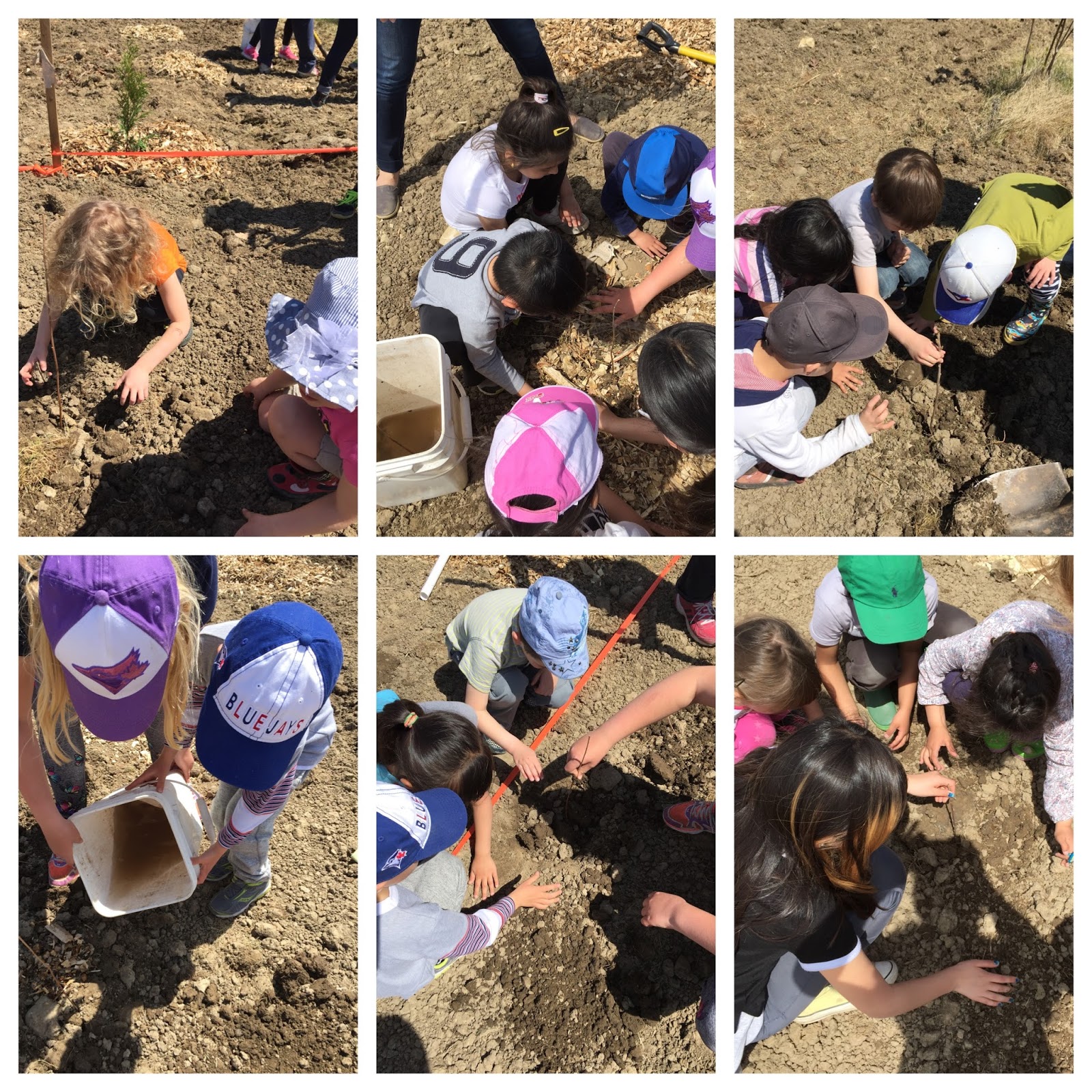
Our learners are passionate about helping save energy and not cutting down the trees. They have been making connections to our learning about polar bears (click here for link) and how we need to save energy to help the planet. With their focus on not cutting down trees, we felt it would be important to provide an opportunity for our learners to plant trees. Then we found out Grade 5s were planting trees! We were so excited to join in on the hard work!


Stomping on the soil to pack it down
Digging the hole 


We were so impressed with each learner as they got their hands dirty and worked in the heat to plant a tree. They all felt very accomplished. It brought their learning to life!


We are so excited to continue to learn about trees and their roles in our lives!

Wednesday, 4 May 2016

Math can be found anywhere!

What is so wonderful about the kindergarten program is the authentic learning opportunities that arise in the least likely places! We had set out a provocation about the human body with x-rays at the light table.


At first our learners were excited, but didn't spend much time here. We left it out hoping someone would be inspired. Our patience paid off, D.A. began exploring the rib x-ray and wondered how any ribs there were. She used the toothpicks to re-create the ribs.


Other learners came over to see what she was doing. They then began connecting some of the x-rays. Ms. Tompkins encouraged them to use the floor to have more space. 

This group began working collaboratively and problem solving how to put the body together.
 The dialouge between this group was incredible. They were stating ideas, explaining their reasoning, and justifying their placements of the x-rays.


Here is a snippet into some of the conversation (Can you find the math?):

L.L- "This is long"
I.D- Maybe this?
L.L- And then...
I.L- That's the neck
L.L- This is the eye


A.R- Can I see?
D.A- It goes here! I got it!
L.L- That's shorter, that's long. That one is wrong, it's supposed to go on this side. Look, this side is this side, and that's there.
A.R- See? Here!
I.L- No no no, that's not the way it goes.
L.L- Oh!
I.L.- Where's the head?
A.A- The skull.
L.L- Is it like that?
A.R- I don't know!
A.A- Yeah it is!
I.L.- This is an arm piece, but where does the arm go?
A.R.- Look here! I think I know

The finished skeleton (we realized not all the x-rays were there, since the legs were different lengths)
The students then began to wonder about how many bones were in the body. We talked about how they could find out. D.A. told them about how she used toothpicks to help her count the ribs. So together they worked using popsicle sticks and toothpicks to match each bone they saw. Before they finished they predicted how many bones they thought were in the body.

I.L- 100
A.R- 50
A.A- 120
L.L- 17
D.A- 40
M.F- 19


They persisted and worked together when adding all the sticks. 


They each began to count the bones but the number got too high. So D.M. decided to count only the arm and record the number on paper. This encouraged the others to do the same. Each learner recorded the number and the body part. They suggested we use a calculator to add up the totals because it was so big! 

Our learners were so proud of themselves for working through this challenge. We were so proud of this group for how well they collaborated, persisted, spoke, counted, recorded and problem-solved. Such great learning!


Be open to authentic experiences, listen to your learners and provide opportunities for thinking. You'll be amazed at the learning that will happen.

Making Sugar Crystals

Our learners are so excited about the sugar crystals we made in class. We told them they can eat them, so we thought we would pass along the ingredients and instructions so you can make them at home.


Materials (what you need):
- sugar
- water
- pot
- container/jar
- long string or stick
- clothes peg
- food colouring (optional)

Procedure (what you do):
1) First you boil water (approximately 1 cup)
2) Then you add sugar (approximately 1 cup) to the boiling water and stir
3) Continue to add sugar until it is not dissolving anymore
4) Add 1-2 drops of food colouring (optional)
5) Pour the mixture into a tall container/jar
6) Dip the stick/string into the mixture let it dry
7) When the stick is dry, sprinkle some sugar on it
8) Put the stick into the mixture using the clothes peg to hold it in place
9) Wait, let it sit for a few days
10) Pull it out and enjoy :)